

A Fusion First: Realta Demos Direct Energy Conversion to Electricity
On June 19th, 2026, Realta Fusion became the first private fusion company in history to successfully demonstrate direct energy conversion (DEC) of plasma kinetic energy into electricity.
June 30th, 2026
by Dr. Derek Sutherland
On June 19th, 2026, Realta Fusion, in collaboration with our partners at the University of Wisconsin-Madison demonstrated direct energy conversion (DEC) on the Wisconsin HTS Axisymmetric Mirror (WHAM) prototype fusion device. This is the first time a commercial fusion company has demonstrated DEC applied to a fusion plasma.
DEC is the process of converting the energy of a fusion plasma manifesting in the form of moving charged particles directly into electricity – real amps of electric current flowing in circuits employed to do useful work.
The prospect of using DEC in eventual fusion power plants has been discussed in the fusion field for decades, with the primary goal of increasing the overall power efficiency of the system. In short, by directly converting fusion plasma power into electricity, we can push less of the energy through a thermal cycle that has inherent efficiency limits due to the laws of thermodynamics. We believe DEC will be especially attractive for magnetic mirror fusion power plants.
A bit of background and context before describing what we just achieved on WHAM.
Background and context
The physics of magnetic mirror confinement is well known to provide a natural “loss cone” of charged particles in velocity space. Both charged ions and electrons making up our fusion plasma start off well confined in the mirror but eventually pitch-angle scatter into the loss cone via Coulomb collisions. We can shrink the size of this loss cone and so improve plasma confinement by using large magnetic fields generated by high-temperature superconducting (HTS) magnets. This superconducting technology along with our axisymmetric geometry allows us to access higher mirror ratio – the ratio of the magnetic field at the mirror throat relative to the weaker field in the center cell region. Increasing the mirror ratio improves plasma confinement, providing a pathway to sufficiently high fusion gains needed for a fusion power plant. [1]
Confident about our path toward a viable power balance in a fusion power plant, we now consider the leakiness of magnetic mirrors as a compelling feature rather than a hurdle to overcome.
- First, the leakiness of magnetic mirrors allows for the natural exhaust of both charged fusion products (i.e., helium ash) and impurities in the loss cone, so the fusion plasma fuel stays clean and making fusion power continuously.
- Second, the charged fusion products and the other ions and electrons making up the plasma exhausting into the loss cone provides us the opportunity to recapture their energy via DEC at a much higher efficiency instead of pushing all energy through a thermal cycle with lower overall efficiency.
For first-generation deuterium-tritium (DT) fusion power plants, 80% of the yield will come in the form of high-energy neutrons and 20% in the form of charged helium nuclei called alpha particles. The neutron portion of the yield is converted into heat in a moderating blanket and used directly as process heat or used to spin turbines and make electricity. However, since alpha particles are charged particles, they can stay confined for a long enough time in the mirror to deposit their energy back into the plasma to heat it before exiting out the ends.
By then capturing a large fraction of both the alpha power and input power in the system using DEC in the expander region of our mirrors, the total efficiency of the system can be improved significantly. You can think of a DT fusion power plant with DEC like a hybrid powertrain in a vehicle – it generates heat to push pistons (or in our case, spin turbines) for most of the power but with an electric component to improve efficiency.
We believe we can generate enough electricity using DEC in our design points to completely cover the input power requirement of the system for continuous operation, leaving the heat component for either direct use or the generation of electricity for customers.
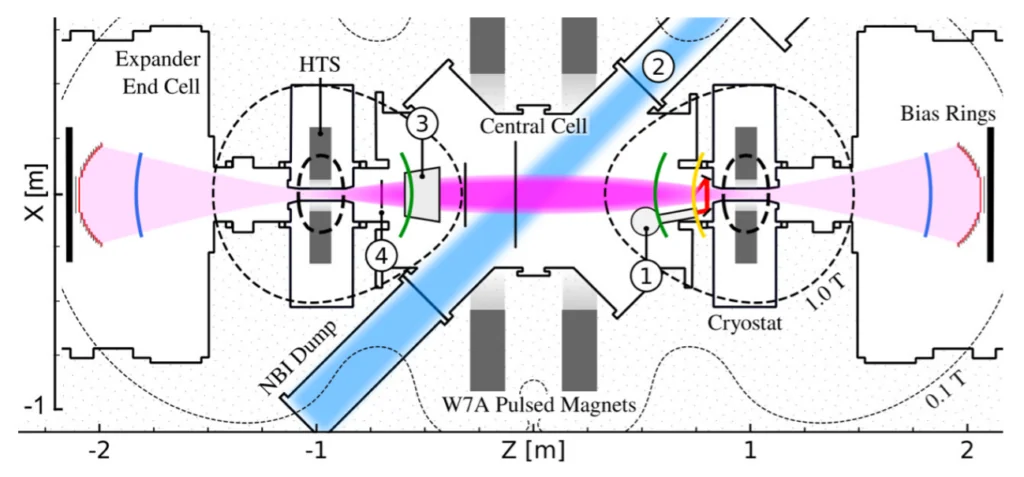
WHAM device overview. Figure source: D. Endrizzi et al., Physics basis for the Wisconsin HTS Axisymmetric Mirror (WHAM), J. Plasma Physics 89, 975890501 (2023).
WHAM DEC Demonstration
In this demonstration, a direct energy converter was installed on our end-ring assembly in WHAM by replacing the center disk with it. This converter slows down incident charge particles exiting through the loss cone of the mirror using an electrostatic potential, converting their kinetic energy directly into electricity during mirror fusion plasma operations.
This first prototype is a single-stage DEC converter composed of three finely meshed grids – an electrically grounded grid, an electron repulsion grid, and an ion collector grid. During mirror plasma operations, this assembly currently draws multiple amps of current at around 100 volts – providing sufficient power to illuminate a few lightbulbs. We will continue scaling the voltage of our direct energy converter to draw even more current in the coming weeks.
We have demonstrated the conversion of a portion of our input power coming out the ends of the mirror in the form of charged particles directly into electricity on WHAM. In future devices designed for high fusion power production, a greater fraction of this converted power will be coming directly from fusion. At Qsci = 5 in a DT plasma, the alpha power will become equal in magnitude to the input power into the plasma to keep it operating continuously. But WHAM is a prototype scale magnetic mirror device using only deuterium fusion fuel, and so most of the directly converted energy is of the input power we are supplying the mirror plasma to heat and sustain it.
Lastly, and just as important as to what we’ve shown on WHAM with this first DEC demonstration, is clarity on what we have not shown yet: this is neither a demonstration of net-electricity production nor large-scale conversion of fusion-born power directly into electricity – these are milestones we will achieve on our future devices at Realta.
The path ahead for DEC at Realta
Working with the philosophy of “first make it work, then make it good,” it’s now on us to scale what we’ve done on WHAM to multi-kW and ultimately multi-MW capability in our future devices. But, even with this first demo, our path to commercial DT mirror fusion power plants just got clearer.
The real strength of DEC for magnetic mirrors using DT fuel is recapturing the input power from the neutral beams, electron cyclotron, and ion cyclotron heating at a much higher efficiency than pushing it all through a thermal cycle. This capability, when scaled up, will allow us to achieve “net-electric” conditions at a much lower fusion gain (Qsci) than other magnetic confinement approaches, as detailed in [2] DEC isn’t a hard requirement for our mirror fusion power plants to work, but it will give us greater flexibility in our product offerings.
Lastly, thinking beyond our first-generation DT mirror fusion power plants, the use of DEC makes the used of advanced fuel cycles – such as catalyzed D-D or D-3He – more plausible because more of the fusion yield will be in the form of charged fusion products that will exit the ends of the mirror through the loss cone. By using DEC with advanced fuels, we could potentially rely less on a thermal cycle to generate electricity and sidestep the need for large-scale tritium breeding – both could result in additional cost savings for our future fusion power devices geared on generating electricity. Though we are currently focused on developing a DT mirror fusion power plant first, the physics of the magnetic mirror and the architecture that naturally allows for DEC motivates us to consider advanced fusion fuel cycles that require higher plasma temperatures than DT in pursuit of even lower cost fusion power plants.
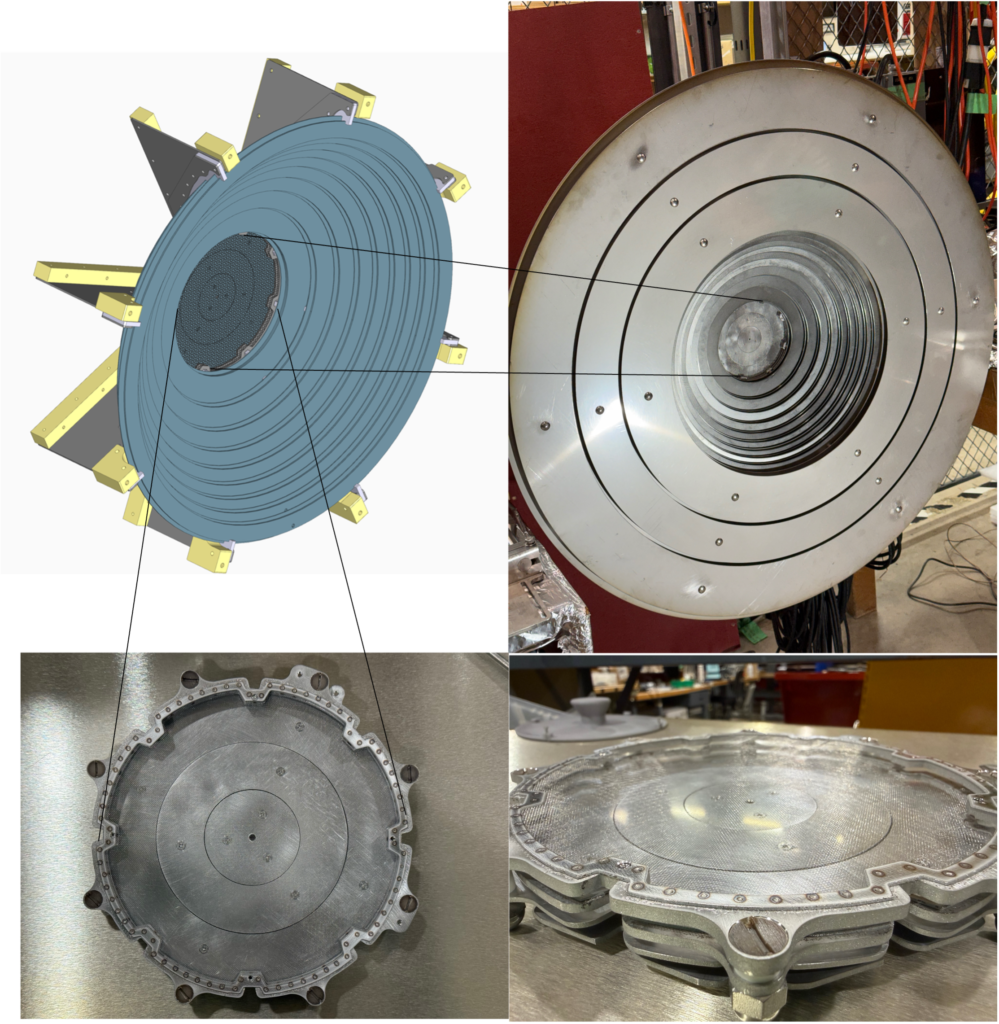
Single-stage direct energy converter on WHAM. Upper left: Direct energy converter installed in the center of the end-ring in CAD. Upper right: Assembled system ready for install on WHAM. Lower left and right: Zoomed in pictures of the direct energy converter assembly head on and at an angle showing the three-layer grids used for this first prototype. Special thanks to Dmitry Yakovlev (UW-Madison), Tucker Peterson (UW-Madison) and Ty Omark (Realta Fusion) for their work on the converter.
[1] S. Frank, et al., Confinement performance predictions for a high field axisymmetric tandem mirror, J. Plasma Phys. 91, E110 (2025).
[2] S. Wurzel and S. Hsu, Progress toward fusion energy breakeven and gain as measured against the Lawson criterion, Phys. Plasmas 29, 062103 (2022), https://doi.org/10.1063/5.0083990